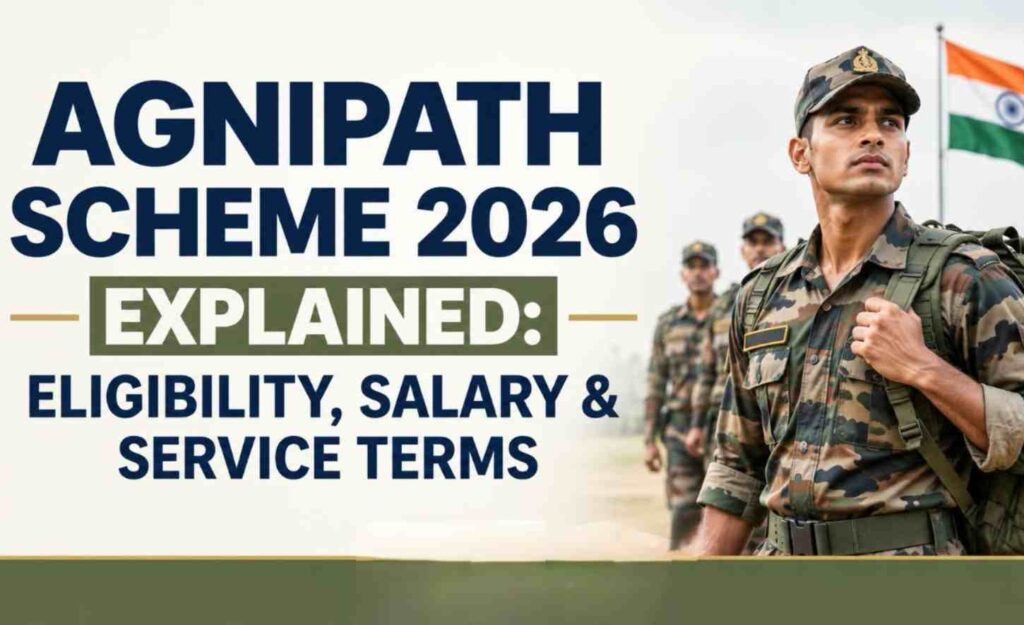
The Agnipath Scheme is a new way of hiring young people for the Indian Armed Forces, and it was brought in by the Ministry of Defence, the government department that looks after the country’s military. It covers the Indian Army, the Indian Navy and the Indian Air Force, and everyone selected under it is called an “Agniveer”.
The idea behind it was to build a force that is younger, comfortable with technology and full of energy, which is why it looks so different from the older way of hiring, where a person joined for 15 years or more and then received a pension for life.
Under Agnipath, a person joins for four years, spends the first part in hard military training and the rest in active service, and then either leaves with a payment or gets a chance to stay on in the regular force. Because the rules, trades and duties are not the same in the Army, Navy and Air Force, anyone who wants to apply should read the official 2026 recruitment notice of their chosen service before filling in the form.
This guide explains the main rules, the money and the service conditions for Agniveers in 2026.
What Is the Agnipath Scheme?
The Agnipath Scheme is a short-service plan for hiring people below officer rank into the Indian Armed Forces. Those who join are called Agniveers, and during their four years they hold a separate rank of their own in the military. In the older system a person got 15 or more years of service to begin with and a pension for the rest of life,
but Agnipath works on a fixed period instead, which means the service ends after four years unless the person is chosen to stay. It gives young citizens a chance to live a disciplined military life, learn useful technical skills and take part in real duties, and at the same time it keeps the average age of military units lower.
Agniveer Eligibility in 2026
The eligibility rules for Agniveers in 2026 depend on which service you apply to, whether Army, Navy or Air Force, and also on the trade you choose, so it is important to check the exact rule for your own trade. In general, the age range for applying is 17.5 to 21 years in all three services.
The education needed is not the same everywhere, because general duty posts usually ask for a pass in Class 10, while technical trades in the Air Force (called Agniveervayu) and in the Navy ask for Class 12 with Physics, Chemistry and Mathematics, or an approved technical diploma. Candidates must also meet strict physical standards such as height, chest expansion and stamina, and they have to pass a medical fitness test that differs from one service and trade to another.
How Agniveer Recruitment Works
The selection has several stages, but the order and the way of testing change from one service to another. Most candidates begin by applying online on the official websites, such as Join Indian Army, Join Indian Navy or Agnipath Vayu, and after that they usually sit for a computer-based test known as the Common Entrance Examination (CEE), or a written test.
Those who pass go on to the Physical Fitness Test (PFT), which includes timed running, pull-ups and similar tasks, and the ones who clear that stage are then checked in detail by military doctors. The final list is made on merit, which means marks and performance, for each trade and for each region’s share of seats, and it covers the whole of India.
Agniveer Salary and Pay Structure
The monthly package for an Agniveer goes up a little every year over the four years, and it looks like this:
- First Year: Monthly package of ₹30,000.
- Second Year: Monthly package of ₹33,000.
- Third Year: Monthly package of ₹36,500.
- Fourth Year: Monthly package of ₹40,000.
Out of this package, 70% is paid to you in hand every month, which comes to ₹21,000 in the first year and ₹28,000 in the fourth year, while the other 30% is kept aside in a savings fund called the Agniveer Corpus Fund, and this deduction is compulsory. Agniveers do not get Dearness Allowance (DA), which is extra money paid to cover rising prices, or Military Service Pay (MSP), which is a special pay given to regular military personnel, but they can get risk and hardship allowance, dress allowance and travel allowance, depending on where they are posted and how tough the conditions are.
Seva Nidhi Package Explained
The Seva Nidhi package is the lump sum of money an Agniveer receives when the four years are over. The 30% that is cut from your monthly package goes into the fund, and the Government of India adds exactly the same amount to it, so that over four years you put in about ₹5.02 lakh and the government puts in another ₹5.02 lakh.
When the interest that gets added along the way is included, the total payment to an Agniveer who is leaving comes to about ₹11.71 lakh, and this whole amount is tax-free. This money can help you pay for higher studies, start a small business or take up a training course.
Four-Year Service Period: What It Means
The four years include the first military training, which usually lasts about six months, and after that the Agniveer is sent to active duty in a field unit or a naval unit. During this time an Agniveer must follow the rules of military discipline, or the naval or air force rules, depending on the service joined.
There is also a life insurance cover of ₹48 lakh for the whole period, and the Agniveer does not have to pay anything for it. Annual leave is 30 days every year, and medical leave is given when the military doctors advise it, but the service comes to an end on its own after four years unless the person has been picked for regular enrolment.
What Happens After Four Years?
When the four years are complete, an Agniveer leaves the regular military system unless he or she has been chosen to stay. Those who leave receive the tax-free Seva Nidhi amount along with an official “Agniveer Skill Profile Certificate”, which lists the training they took and the skills they gained. To make the move to civilian life easier, several central paramilitary forces (CAPFs), state police services and government-owned companies give some preference in hiring or allow extra age relaxation to former Agniveers.
Who Gets Permanent Retention?
Getting a permanent place in the regular force is limited and there is a lot of competition for it. Under the main rules of the scheme, up to 25% of each batch of leaving Agniveers can be taken into the regular cadre, which means the permanent, long-term staff, of their own service. Nobody has a right to this, because the choice depends on what the service needs, on how well the person has done, on physical tests and on the overall record built up over four years. Those who are kept on then serve under regular terms and become eligible for the normal military pension after that.
Benefits and Limitations of the Agnipath Scheme
The scheme has clear advantages, but it also has limits that every candidate should understand.
- Key Benefits: Strong military discipline, useful skills, free life insurance cover, a money base through the tax-free Seva Nidhi package, and a better chance in several public safety jobs.
- Key Limitations: The service period is short, there is no pension for those who leave after four years, there is no MSP, and it is hard to win a place in the regular cadre.
| Aspect | What It Means | Important Point | 2026 Verification |
| Eligibility | Age, education and fitness rules differ from one service to another. | The age range stays at 17.5 to 21 years for normal entry. | Check the trade qualifications in the official notice of the service. |
| Salary | A fixed yearly package of ₹30,000 to ₹40,000 per month. | 30% is cut every month for the corpus fund. | In-hand pay is between ₹21,000 and ₹28,000 per month. |
| Service Period | Four years fixed, which includes training and duty. | It includes ₹48 lakh life insurance that costs the Agniveer nothing. | The service ends on its own after 48 months. |
| Exit and Retention | Up to 25% stay in the regular cadre, and the rest leave with Seva Nidhi. | Those who leave get a tax-free package of ₹11.71 lakh. | Retention is competitive and depends on performance. |
Important Things Candidates Should Check Before Applying
Before you send in your application, read the official 2026 recruitment notice of the service you want to join, and read it slowly. You should check the education marks needed for each trade, the physical measurements asked for (for example, the height relaxation given in some regions), the medical rules and the topics that will come in the online exam. Also make sure that your papers, such as your caste certificate, domicile record and educational mark sheets, match exactly what the official notice asks for.

Conclusion
The Agnipath Scheme 2026 gives young people a clear way to enter the Indian Armed Forces, with hard military training and a good short-term money package. It teaches discipline and gives a large tax-free amount at the end, but candidates should also remember that only a limited part of each batch, decided by performance, gets a permanent place. It is always best to read the official recruitment notice fully before applying.
Get the latest Agniveer updates by joining our WhatsApp channel
Frequently Asked Questions
Q1. What is the Agnipath Scheme?
Q2. How long does an Agniveer serve under the scheme?
Q3. Is permanent Army, Navy or Air Force service guaranteed?
Q4. How does Agniveer salary work?
Q5. What is the Seva Nidhi package?
Q6. Can Agniveers be retained after four years?
Q7. Are Army, Navy and Air Force Agniveer rules identical?
Q8. Where should candidates verify the latest 2026 eligibility rules?
READ ALSO: FLAT FOOT AND AGNIVEER SELECTION — THE DEFINITIVE GUIDE