

Under the Agnipath scheme, the Agniveer salary structure brings in a modern financial model for military personnel across the Indian Army, Navy, and Air Force. To understand this pay system, candidates need to look beyond the headline figure, because the advertised monthly package is quite different from the actual amount you take home.
The official financial structure combines direct monthly pay, a compulsory personal contribution, a matching government deposit, and allowances that depend on where you are posted. Over the four years of service, the basic pay goes up every year, reflecting your growing experience.
Candidates need to understand the difference between their gross earnings and what they actually receive, because 30 percent of the monthly customised package goes into a dedicated fund called Seva Nidhi. The Indian government matches this exact amount every month, building up a solid financial cushion, which is paid out once the service is complete. Other elements like risk, hardship, ration, and travel benefits change depending on where a soldier is posted and the rules of their specific service branch.
Since financial conditions, tax rules, and official recruitment notices decide these figures, candidates should rely strictly on official documents, rather than unverified sources. This detailed guide gives you an accurate, year-wise breakdown of the Agniveer salary, including the deductions, the in-hand amount, how the Seva Nidhi fund builds up, and the options available after service ends.
What Is Agniveer Salary?
The Agniveer salary is a customised financial package, designed specifically for short-term service in the Armed Forces. Unlike the traditional permanent military pay scale, which has complex pay bands and military service pay, this pay system follows a simple, structured model. Candidates get a fixed customised monthly package that goes up every year, over the four years of service.
This overall package should not be confused with your take-home pay. Your net monthly earnings are worked out after taking away the compulsory contribution that goes into the dedicated fund. Because of this deduction, while the total pay is higher on paper, the direct monthly amount you actually get stays smaller than the full package.
Agniveer Salary Year-Wise
Your pay follows a set yearly increase, over the four years of service:
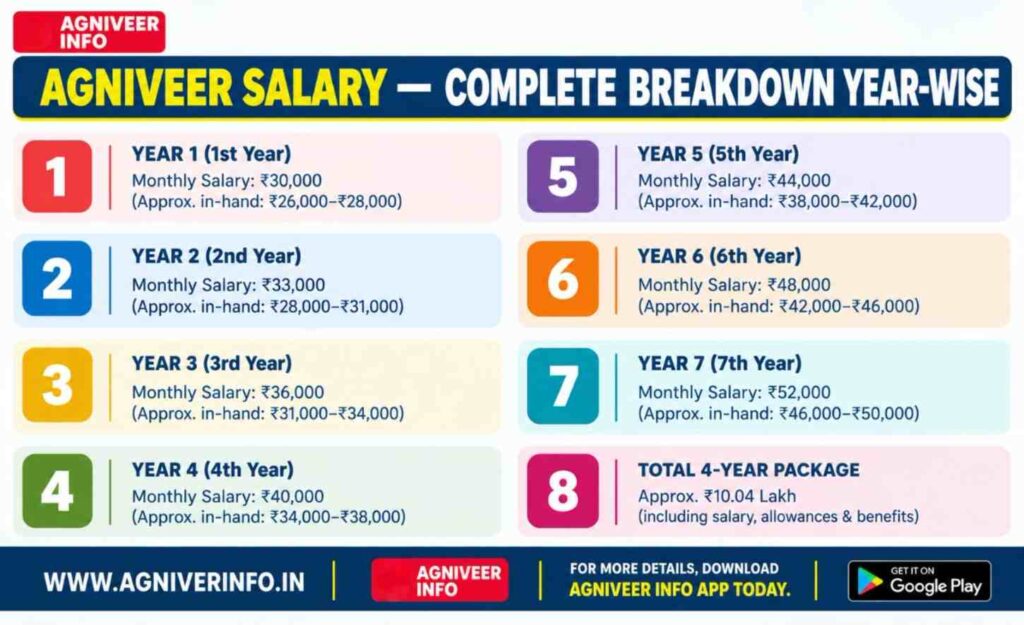
- Year 1: The customised monthly package starts at ₹30,000. Out of this, 30% (₹9,000) is deducted for the Seva Nidhi fund, leaving a fixed in-hand salary of ₹21,000 per month.
- Year 2: The monthly package goes up to ₹33,000. Your own contribution comes to ₹9,900, giving you a net monthly take-home pay of ₹23,100.
- Year 3: The total monthly package reaches ₹36,500. With a monthly deduction of ₹10,950 going into the fund, the in-hand salary rises to ₹25,550.
- Year 4: In the final year, the customised monthly package rises to ₹40,000. Your contribution reaches ₹12,000, leaving an in-hand monthly salary of ₹28,000.
Agniveer In-Hand Salary
The Agniveer in-hand salary is the exact net amount that gets deposited into a soldier’s bank account every month. While the basic deduction stays fixed at 30 percent across all four years, the final take-home amount can change slightly, depending on the specific allowances and any authorised deductions that apply.
Things that affect your monthly take-home amount include your posting location, your operational duties, and whether you qualify for a specific allowance. This is why candidates posted in high-altitude or high-risk areas may get extra monthly allowances, which raise their final take-home amount above the basic figure.
Agniveer Seva Nidhi Package
The Seva Nidhi package is a savings benefit built up over time, meant to help personnel once they finish their four years of service. Every month, 30 percent of the candidate’s customised package is put into this fund, and the Government of India adds an equal matching amount into the soldier’s own Seva Nidhi account.
Over the four years, the candidate’s own total contribution comes to about ₹5.02 lakh, and this is matched by another ₹5.02 lakh from the government. On exit, the candidate gets the combined amount of about ₹10.04 lakh, plus the interest earned. This lump sum is completely separate from the regular monthly pay.
Agniveer Salary Allowances and Benefits
Along with the customised monthly package, Agniveers also get specific allowances and non-cash benefits, suited to military life:
- Risk and Hardship Allowance: Paid based on where a soldier is posted, and how tough that location is.
- Ration and Clothing: Free rations, clothing, and uniform allowances, as per the service rules.
- Travel Benefits: Official travel concessions and allowances for duty and leave.
- Medical Facilities: Medical cover and access to the military healthcare system, during service.
These allowances depend on the specific posting, and are not given to every soldier equally.
Agniveer Salary in Army, Navy and Air Force
The basic salary structure, the monthly package, the deduction rate, and the Seva Nidhi contribution are all the same across the Indian Army, Indian Navy, and Indian Air Force (Agniveervayu), since the common rules of the Agnipath scheme govern the basic pay structure across all three services.
The differences that come up are purely because of the different working conditions in each service. For example, a Navy soldier posted at sea, or an Air Force technical staff member, may get their own branch-specific allowances, based on their technical trade, sea duty, or any hazardous task they are given.
Salary During Four Years of Agniveer Service
Over the four years of service, the pay steadily goes up, moving from ₹30,000 a month in the first year, to ₹40,000 in the fourth year. The total combined package over the four years comes to ₹16.76 lakh, with the total net in-hand earnings coming to about ₹11.72 lakh, before adding any location-based allowances.
At the end of the four years, personnel move out of the scheme, and receive their full, built-up Seva Nidhi fund. This structure makes sure there is regular saving happening, alongside the monthly pay.
What Happens to Salary After Four Years?
Once the four years of service are complete, up to 25 percent of each batch may be taken into the regular cadre of the Armed Forces, based on the organisation’s needs and the soldier’s performance. Those chosen for permanent service move on to the regular military pay scale, regular allowances, and standard service conditions.
The rest of the personnel leave active service and get their Seva Nidhi package. They do not get an ongoing military pension or a regular monthly salary after this, unless they are employed somewhere else afterwards.
Is Agniveer Salary Taxable?
The income tax rules for Agniveers follow the current tax laws set by the Government of India. Generally, the regular monthly in-hand pay and any allowances that apply are subject to income tax, under the standard tax slabs.
However, the official rules make the final Seva Nidhi package, which includes the government’s contribution and the interest earned, completely exempt from income tax. Candidates should check the current official tax rules, or speak to a certified professional, for advice specific to them.
| Service Year | Monthly Package | Candidate Contribution / Deduction | Approximate In-Hand / Key Note |
| Year 1 | ₹30,000 per month | ₹9,000 (30% mandatory contribution) | ₹21,000 plus applicable location allowances |
| Year 2 | ₹33,000 per month | ₹9,900 (30% mandatory contribution) | ₹23,100 plus applicable location allowances |
| Year 3 | ₹36,500 per month | ₹10,950 (30% mandatory contribution) | ₹25,550 plus applicable location allowances |
| Year 4 | ₹40,000 per month | ₹12,000 (30% mandatory contribution) | ₹28,000 plus applicable location allowances |
Conclusion
The Agniveer salary structure balances monthly financial support with a structured, long-term saving plan. Through the yearly increase in pay, the monthly package rises from ₹30,000 in the first year to ₹40,000 in the fourth year.
A compulsory 30 percent deduction, matched by an equal government contribution, builds up the substantial Seva Nidhi package, which is paid out at the end of the four years of service. Location-based allowances give extra earnings, depending on where a soldier is posted. Candidates should thoroughly check the official notices, to understand exactly how the base package, the deductions, the tax rules, and the operational allowances all come together, to decide the total pay during and after service.
Get the latest Agniveer updates by joining our WhatsApp channel
Frequently Asked Questions
Q1. What is the monthly Agniveer salary in the first year?
Q2. Does Agniveer salary increase every year?
Q3. What is the difference between salary package and in-hand salary?
Q4. What is the Agniveer Seva Nidhi package?
Q5. Does the government contribute to Seva Nidhi?
Q6. Are Agniveer allowances included in the salary?
Q7. What happens to salary after four years?
Q8. Does every Agniveer receive the same salary?
READ ALSO: AGNIVEER SWEATY HANDS REJECTION EXPLAINED — INDIAN ARMY